📜 Journal Club | Airway Occlusions to Measure Inspiratory Effort, Respiratory Drive, and Lung Mechanics During Noninvasive Ventilation
By: BETINA SANTOS TOMAZ, FISIOTERAPEUTA - 09/25/2026 13:42
🧐In June of this year, Dr. Francesco Murgolo (University of Bari “Aldo Moro,” Italy), Dr. Domenico Luca Grieco (Fondazione Policlinico A. Gemelli IRCCS / Università Cattolica del Sacro Cuore, Rome, Italy), Dr. Salvatore Grasso (University of Bari “Aldo Moro,” Italy), Prof. Massimo Antonelli (Fondazione Policlinico A. Gemelli IRCCS / Università Cattolica del Sacro Cuore, Rome, Italy), and colleagues from a large Italian and international multicenter network published a study in the American Journal of Respiratory and Critical Care Medicine (AJRCCM) entitled “Airway Occlusions to Measure Inspiratory Effort, Respiratory Drive, and Lung Mechanics During Noninvasive Ventilation.”
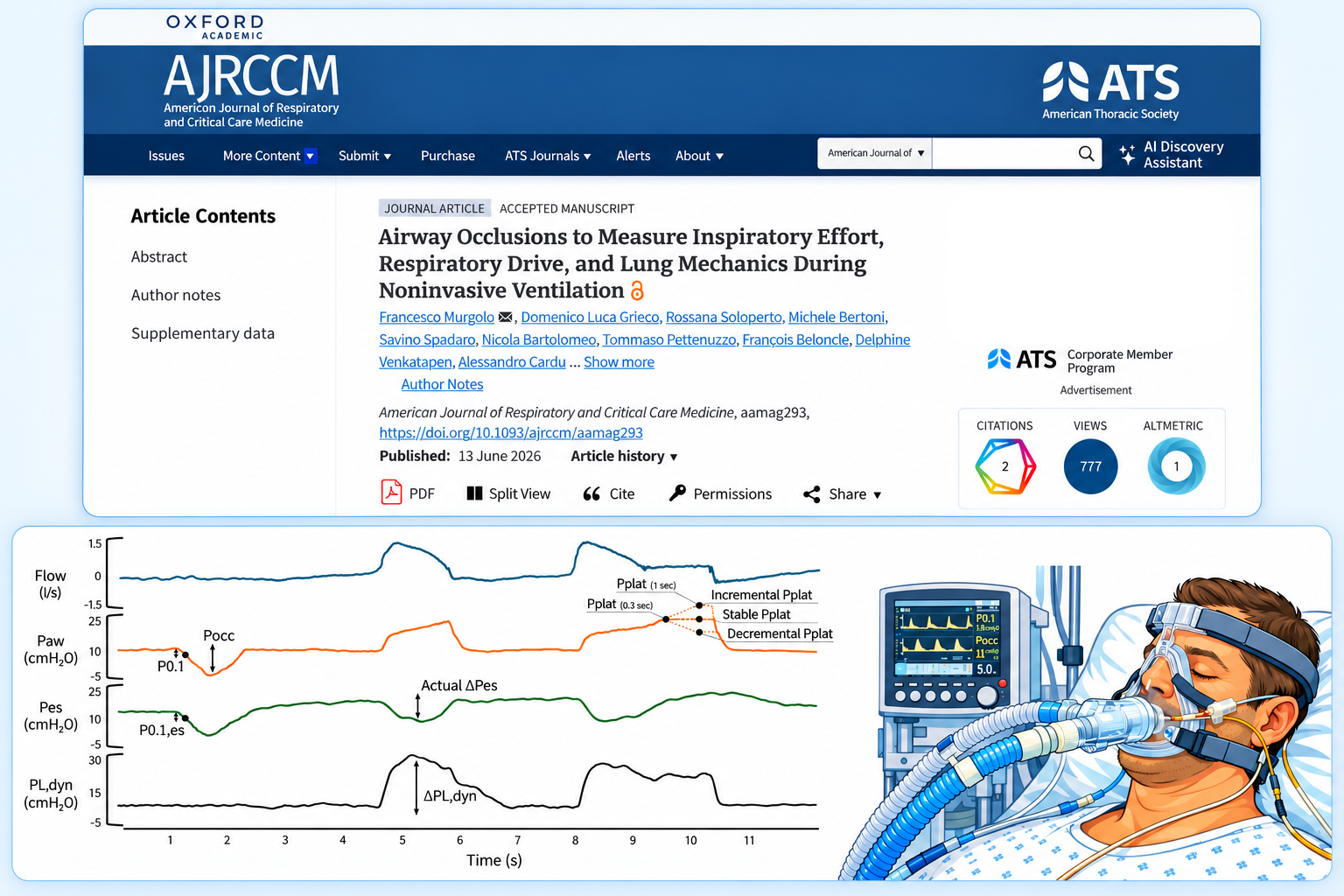
Adapted from Murgolo et al., Am J Respir Crit Care Med, 2026.
The study investigated whether airway occlusion maneuvers could be used during noninvasive ventilation (NIV) to provide bedside estimates of inspiratory effort, respiratory drive, lung stress, and respiratory mechanics.
The multicenter physiological study included 60 high-risk hypoxemic patients after extubation, who underwent two randomized NIV sessions: one using an oronasal mask and the other a full-face mask. End-expiratory and end-inspiratory occlusions were performed to obtain airway occlusion pressure (Pocc), P0.1, and plateau pressure (Pplat). Esophageal manometry, calibrated during invasive mechanical ventilation, served as the reference method for assessing inspiratory effort and transpulmonary pressure.
🙂The findings particularly highlight Pocc as a promising tool for physiological monitoring during NIV.
Pocc-derived estimates of ΔPes showed excellent ability to identify excessive inspiratory effort, with AUCs of 0.98 and 0.97, respectively.
⚠️ In contrast, ventilator-displayed P0.1 was not sufficiently accurate to quantify respiratory drive at the individual patient level. However, high values, > 2.7 cmH₂O with an oronasal mask and > 3.0 cmH₂O with a full-face mask, showed > 90% specificity for identifying high respiratory drive, suggesting that P0.1 may be more useful as a rule-in indicator.
Pplat was even more limited, with a stable plateau obtained in only 22% of patients using an oronasal mask and 10% using a full-face mask, limiting its applicability for assessing static driving pressure during NIV.
🔎 An especially interesting exploratory finding was that greater inspiratory effort, higher dynamic transpulmonary driving pressure, and lower dynamic lung compliance, all estimated from Pocc, were associated with subsequent reintubation. Of the 60 patients, 14 (23%) required reintubation.
These findings suggest that Pocc-derived measurements may eventually contribute not only to physiological monitoring but also to the early identification of patients at higher risk of NIV failure. However, these associations were exploratory and require further validation.
💡From a clinical perspective, the study provides an interesting approach: a brief end-expiratory airway occlusion and measurement of Pocc may provide clinicians with information that currently relies on esophageal manometry, allowing noninvasive estimation of inspiratory effort, dynamic transpulmonary driving pressure, and lung compliance during NIV.
In contrast, P0.1 should be interpreted cautiously, particularly when used to quantify respiratory drive in individual patients, while Pplat appears to have limited applicability in this setting.
📖 Read the full article:
Murgolo F, Grieco DL, Soloperto R, Bertoni M, Spadaro S, Bartolomeo N, et al. Airway Occlusions to Measure Inspiratory Effort, Respiratory Drive, and Lung Mechanics During Noninvasive Ventilation. Am J Respir Crit Care Med. 2026.
To add an answer on this topic and read the replies...
You must have a valid and active xlung subscription
If you are already a subscriber, please Login at the top of the page, or subscribe now